The Ultimate Power Chord Guide: Essential Shapes for Every Genre
When you fret a root with its perfect fifth, you get a power chord that any beginner can play. Experienced players can adapt it to metal, rock, yacht rock, soul, and funk. This lesson covers open and movable shapes across 4 root string zones, then adds inversions and extensions.

Root, fifth and tonal neutrality
A power chord is a two note dyad, written with 5 after the root, as in A5 or D5. It omits the major or minor 3rd, so it is harmonically neutral. The stable perfect fifth and sparse voicing remain clear through distortion, overdrive, and fuzz.
Open shapes become movable
Open E5 covers strings 6 through 4. Mirror it across strings 5 through 3 for open A5. D5 uses strings 4 through 2, while G5 spans strings 3 through 1. Both require a one fret adjustment where strings 3 and 2 meet because Standard tuning places a major 3rd there.
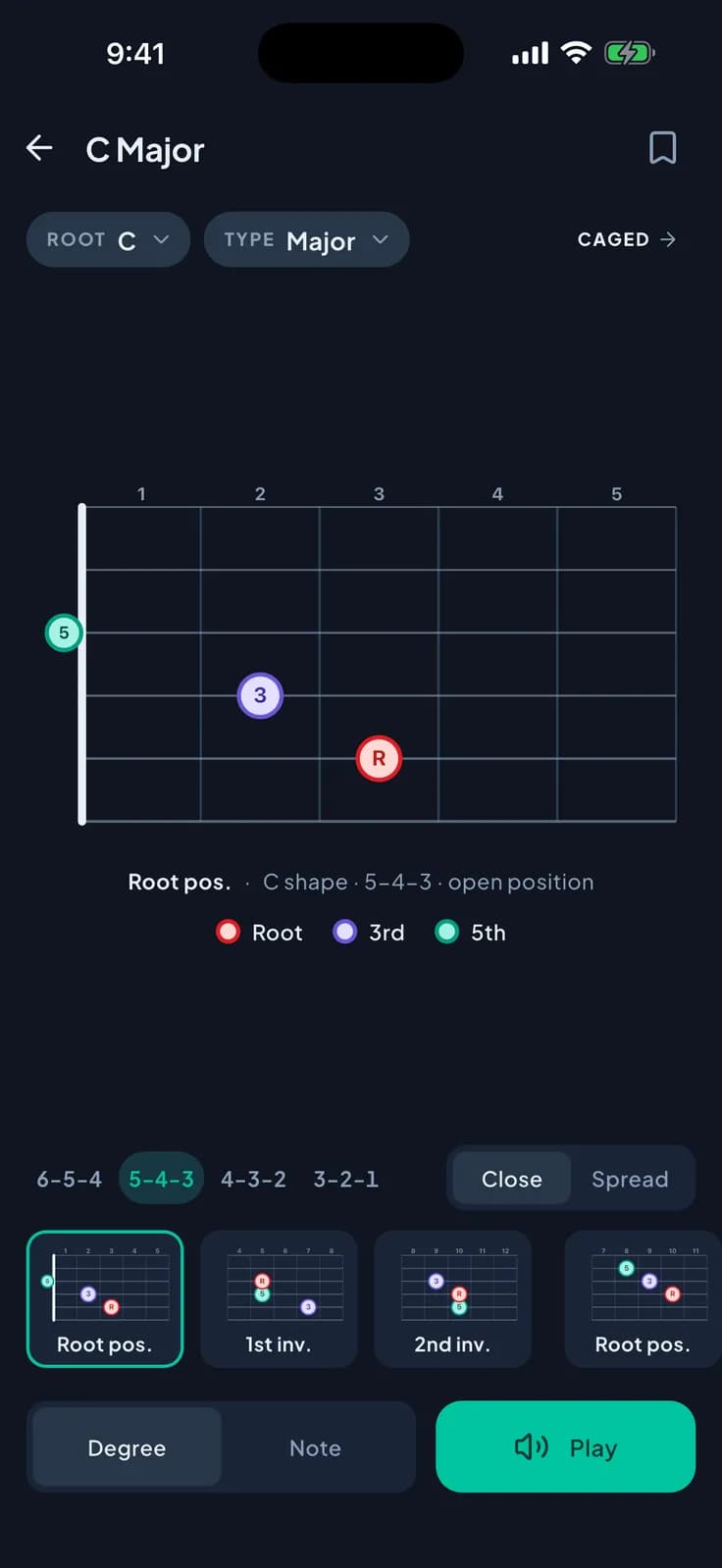
For movable shapes, your 1st finger replaces the nut. Moving E5 to the 5th fret gives A5, while mirroring that shape gives D5 at the 5th fret. On the high strings, fret movable C5 and barre its fifth and octave. Omit the low root to leave a two note inversion.
Four string zones by genre
- Doom metal and hard rock favor roots on strings 6 and 5. The low register suits palm muting, alternate picking, chromatic movement, and occasional flat fives.
- Classic rock, alternative rock, and pop punk use strings 5, 4, and 3 for brighter attack, rhythmic punch, and inverted double stops.
- Yacht rock and AOR place fourth string roots in the middle register. Extensions and color tones add punch to the harmony.
- Soul and funk use third string roots as double stops or three note variants for rhythmic hits and melodic punctuation.
Inversions, sus2 and flat fives
Reverse the root and fifth to produce a perfect fourth double stop, as heard in Smoke on the Water and Layla style riffs. This inversion can free fretboard space for pentatonic riffing. Sliding fourths and arpeggios with sus2 or add9 notes provide further variations. For tension in a heavy riff, lower the fifth by 1 fret to create a flat five power chord.
(Compiled)