Acoustic Bluegrass Primer: Two-Handed Folk-Blues Guitar Lesson
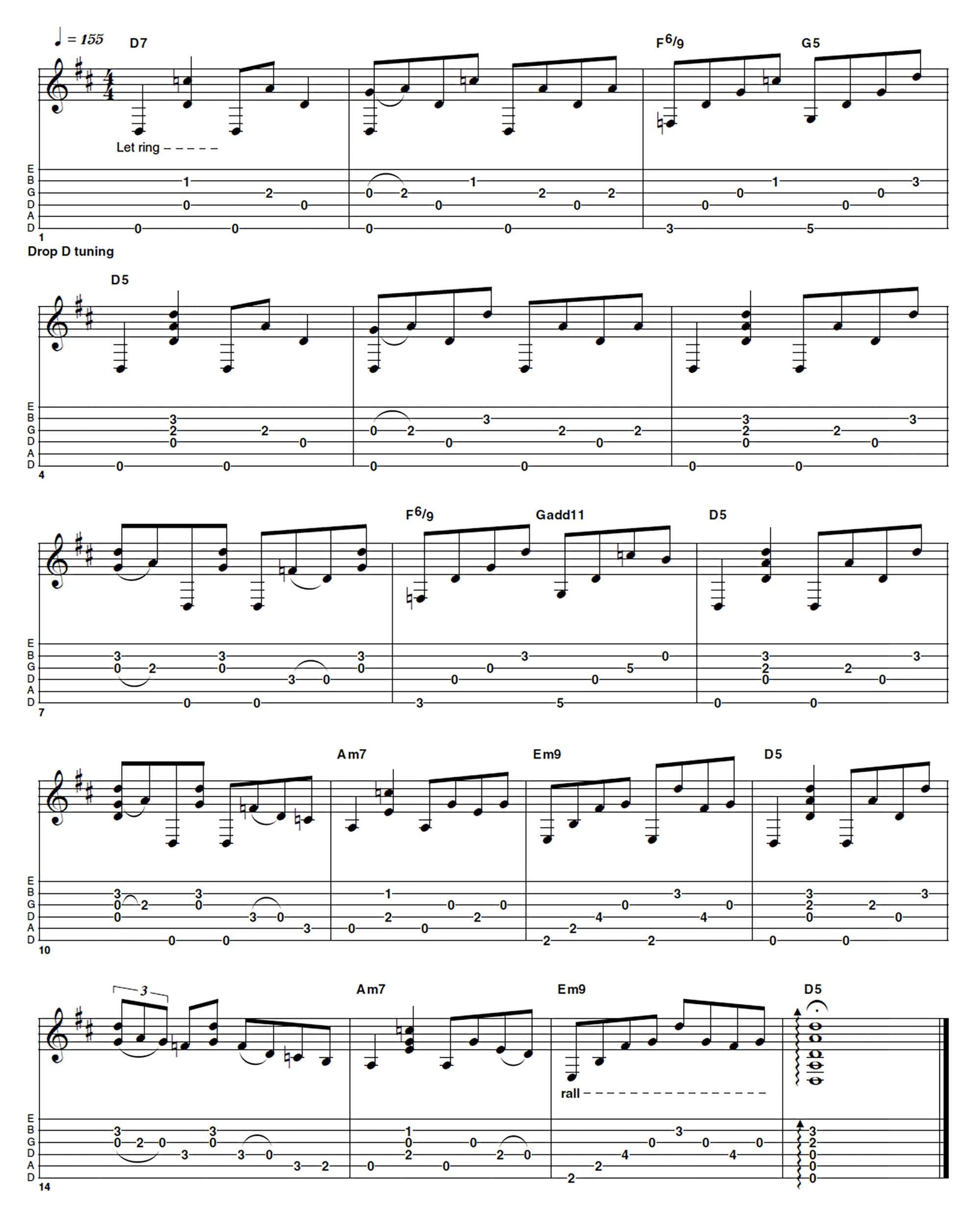
An unaccompanied acoustic exercise blends bluegrass, folk and blues while a steady alternating bass supports the harmony. It suits guitarists developing coordination between bass notes, chords and double-stops without accompaniment.
Build the alternating bass pattern
Use drop D tuning by lowering the low E string by one whole step. The bass generally moves between octaves over D chords, then between the root and 5th over the other chords. The recorded approach uses a pick and fingers, which gives the bass a defined attack and the treble notes a sweeter response. You can also use a thumbpick or play entirely fingerstyle. The first section draws on D7, D5, F6/9 and G5. The unusual F6/9 voicing lets the 3rd and 4th strings ring open as G and D. It omits A, the chord's 3rd, so F6sus2 is another possible name. A later Em9 chord brings in the English folk influence associated with John Renbourn and Bert Jansch. Keep the alternating pulse regular except in bar 7, where the low D moves to beats 2 and 3 around the double-stops. Bar 14 is the only other break in the regular bass rhythm. Slow down across the final 2 bars for the finish.
Why it belongs in daily practice
This exercise develops the coordination needed to hold a bass pulse while placing chords and double-stops above it. Start slowly and tap your foot to keep the pulse steady while muscle memory develops. Practice the bass notes alone, then isolate the chords and double-stops. Combine those layers only when each part feels secure, and leave bars 7 and 14 until the regular pattern stays clear. Crosby, Stills, Nash & Young's 4 + 20 is a close reference for the alternating bass fingerstyle feel. Alison Krauss & Union Station's Paper Airplane provides a flatpicking reference with a precise attack, though its part can also be approached with hybrid picking or fingers. Compare the recordings while listening for bass consistency, treble attack and picking choice.
(Via: Guitar World)