Eric Johnson-Style Blues-Rock Solo in Four Parts
This is a four-part blues-rock solo focused on pentatonic phrases, arpeggios, and Eric Johnson-inspired Texas blues phrasing, published by Richard Barrett. The solo is played continuously, but players should learn each section separately before joining them. It is not a shred exercise, though its articulation demands accuracy, concentration, and a gradual buildup.
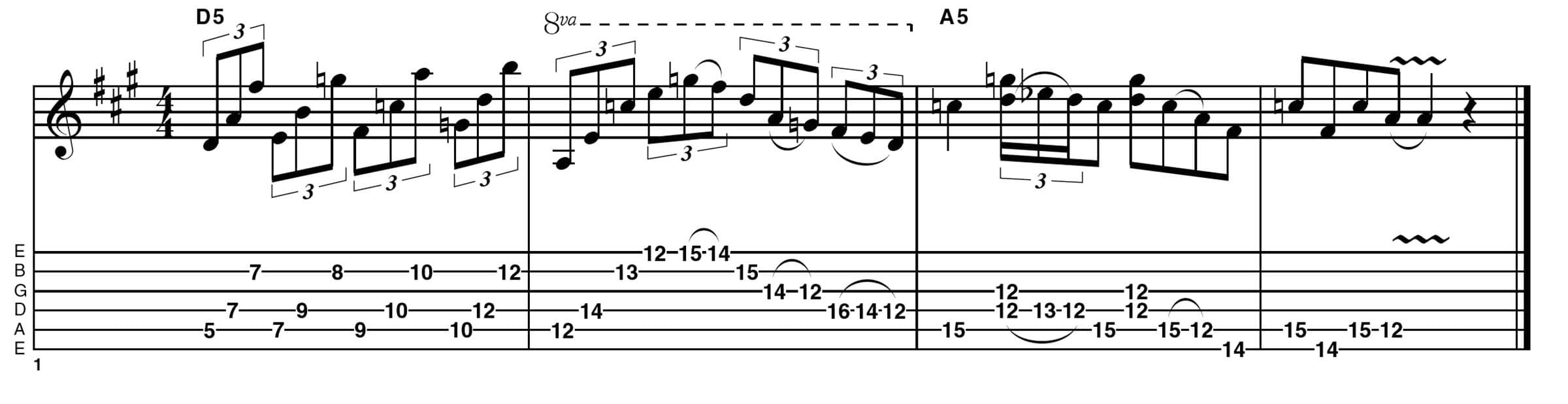
Four sections of Johnson style phrasing
Section 1: Texas shuffle and pentatonic fills
Establish a loose Texas blues shuffle, then add pentatonic fills. Keep the staccato notes short while allowing occasional open 4th and 5th strings to ring.
Section 2: Wide skips and sixths
Pick wide skips drawn from D, Em, D7, G, and Am shapes over a D bass note. Move into a melodic D major run, then play blues influenced double stops and sixths as the bass returns to A. Johnson sometimes combines a pick with his fingers, but this example picks the skips.
Section 3: Slides, legato and a triplet arpeggio
Play the line over C major and D major chords. Use slides and legato to move up the neck, then land on a D major arpeggio, the notes of a chord played one at a time, arranged in triplets.
Section 4: Low E, Mixolydian and a pinched harmonic
Drop to a low E to fill the space between the solo guitar and bass. Follow it with E pentatonic and Mixolydian language, then outline the harmony with an E major arpeggio. Finish with a pinched harmonic by testing the picking motion just behind the neck pickup.
Slow the triplet arpeggio down
The D major triplet arpeggio is deceptively difficult to articulate cleanly. Practice it very slowly and keep your shoulders, arms, and picking hand relaxed. Listen for even triplets and clear notes before connecting it to the surrounding slides and legato moves.
Play the full solo
Once each section feels clean, join them and play the solo as one continuous take.
(Compiled)